
Estonian MP Wins Court Case Over Soviet-Era Flag Incident
Court rules context and intensity key in assessing public order violations
Estonian president's monthly salary tops €10,000 as indexed wages grow.
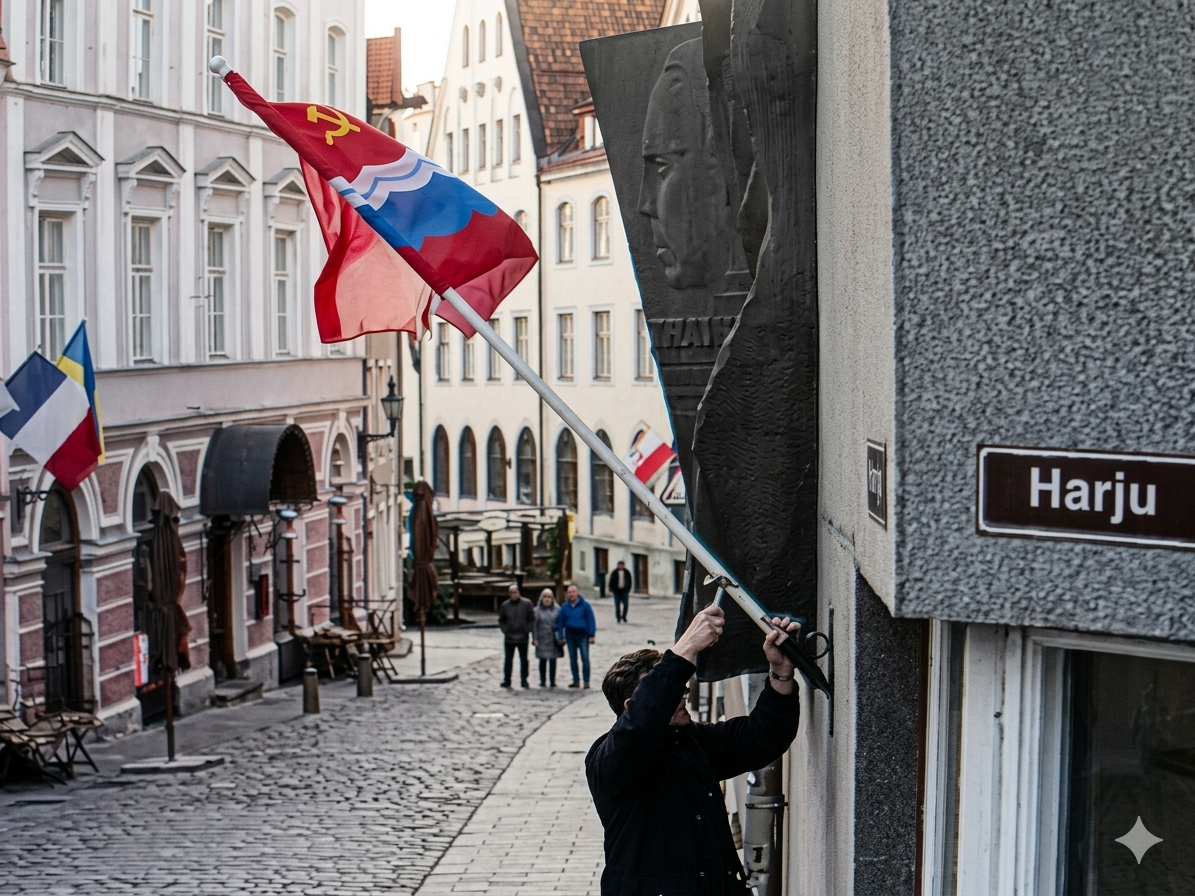
Court ruling (kohtuotsus) in Estonia has overturned a police decision against a member of parliament who displayed a Soviet-era flag in Tallinn’s Old Town. The Harju District Court found that the act did not meet the threshold for a punishable offense, emphasizing the importance of legal interpretation (õiguslik tõlgendus) in cases involving public expression.
The case concerned the raising of the Estonian SSR flag on the wall of the Writers’ House. The court ruled that the incident did not constitute a sufficiently serious disturbance of public order (avalik kord) to justify a misdemeanor penalty. As a result, the state must reimburse legal costs totaling €2,220.
In its reasoning, the court referenced earlier guidance from higher judicial authorities, noting that not every disruption automatically leads to liability. This reflects the principle of proportional response (proportsionaalne reageerimine) in assessing minor offenses.
"The disturbance was not sufficiently intense to meet the elements of a misdemeanor," stated the judge, while also underlining that the use of such symbols is not unrestricted. The decision illustrates how judicial reasoning (kohtulik arutluskäik) must weigh both the act and its broader implications.
The court highlighted that context played a decisive role. In this instance, the display of the flag was connected to a wider discussion about the placement of a cultural work related to a Soviet-era writer. This linkage to public discourse contributed to the assessment of contextual significance (kontekstiline tähendus).
"The court emphasizes that context matters," the judge explained, pointing out that the act formed part of an ongoing debate rather than an isolated provocation. This underscores how freedom of expression (sõnavabadus) can intersect with legal boundaries.
The incident itself dates back to 2023, when the flag was first raised and resulted in a €160 fine imposed by the police. That fine was later overturned, and the same flag was raised again in July of the following year, continuing the controversy and raising questions about symbolic actions (sümboolsed teod) in public spaces.
Authorities retain the right to challenge the decision, as the police may appeal within seven days. This reflects the ongoing role of legal procedures (õigusmenetlused) in ensuring that such cases are fully examined through the judicial system.
The ruling also highlights the balance between maintaining order and allowing public debate. While certain symbols may carry historical and political sensitivity, their use must be evaluated in relation to intent and context, reinforcing the importance of legal balance (õiguslik tasakaal).
At the same time, the court made clear that displaying the Estonian SSR flag is not universally permitted and could be restricted in other circumstances. This indicates that regulatory limits (regulatiivsed piirid) still apply depending on location and situation.
Overall, the case demonstrates how courts navigate complex issues involving history, politics, and expression. By focusing on the intensity and purpose of the act, the decision contributes to a clearer understanding of how public conduct (avalik käitumine) is evaluated under Estonian law.
Key Estonian Vocabulary
kohtuotsus court ruling
õiguslik tõlgendus legal interpretation
avalik kord public order
proportsionaalne reageerimine proportional response
kohtulik arutluskäik judicial reasoning
kontekstiline tähendus contextual significance
sõnavabadus freedom of expression
sümboolsed teod symbolic actions
õigusmenetlused legal procedures
õiguslik tasakaal legal balance
regulatiivsed piirid regulatory limits
avalik käitumine public conduct
For requests or suggestions: pr@estonianinstitute.com

Learn the official language of Estonia in 30 days thanks to the most complete Grammar, Vocabulary and Culture courses available. Start speaking Estonian today!
© Copyright 2026 Estonian Institute